Codex Swarm — DAG-Optimized Parallel Codex CLI Orchestrator
Executive Summary
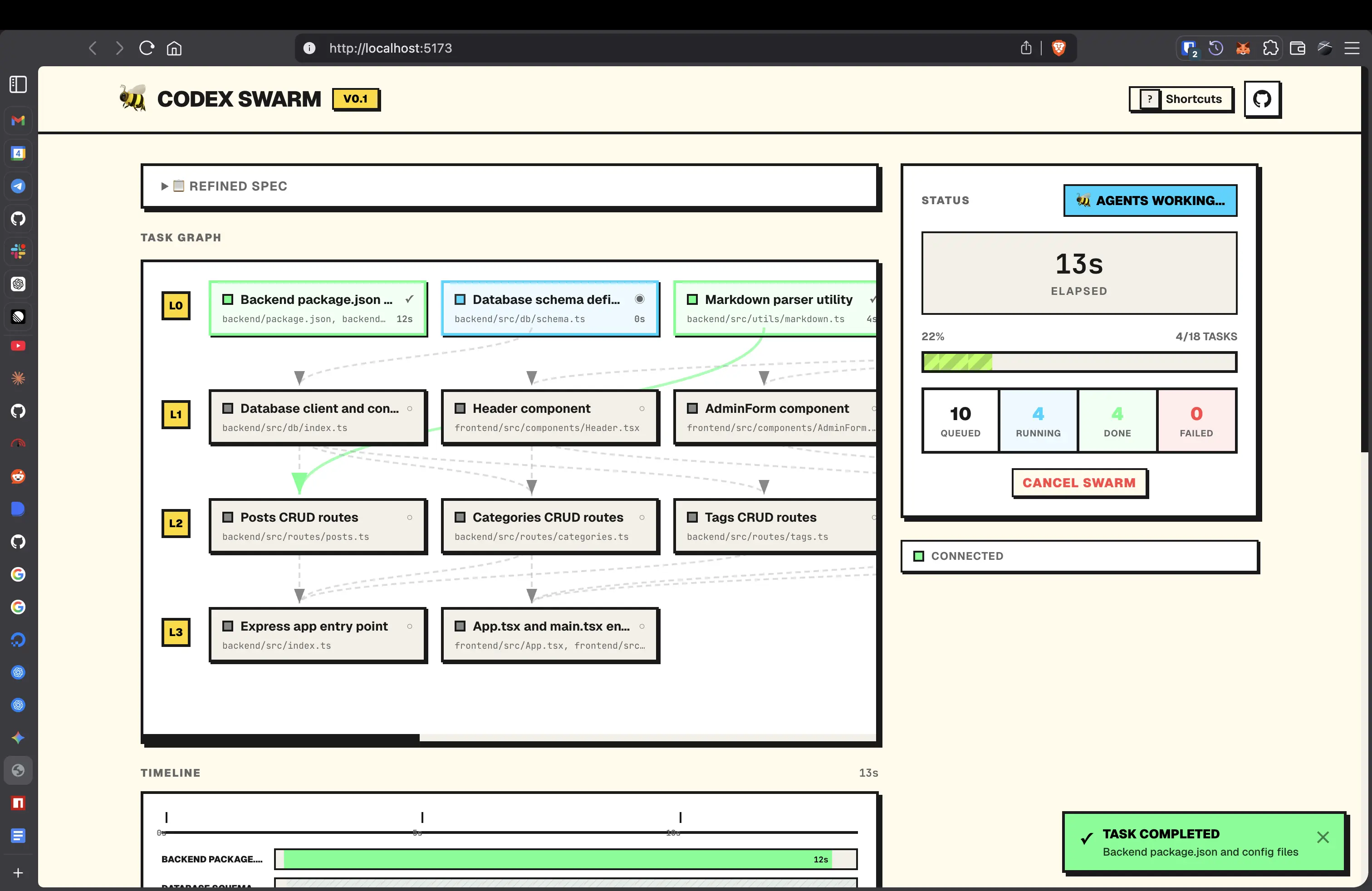
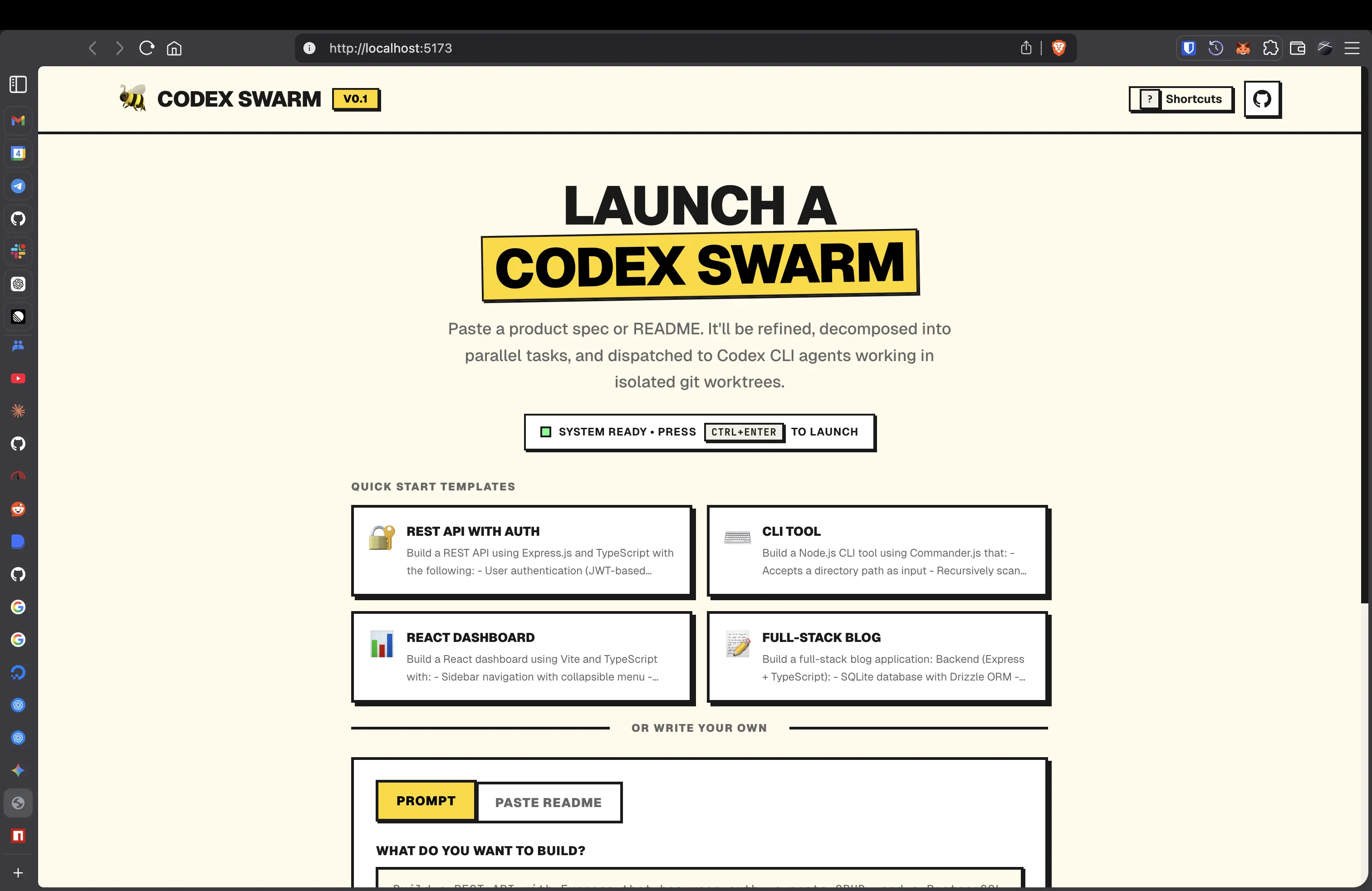
Codex Swarm transforms a single natural-language product specification into a dependency-aware Directed Acyclic Graph (DAG) of coding tasks, then dispatches them to parallel Codex CLI agents running inside Docker-sandboxed containers. A real-time neobrutalist dashboard renders the entire execution pipeline live — from spec refinement through task completion.
The core innovation is a frontier-based DAG scheduler that maximizes Codex CLI throughput by distinguishing between blocking and non-blocking tasks, ensuring maximum parallelization while respecting true data dependencies between tasks.
Problem Statement
Today's Codex CLI workflow is fundamentally sequential and manual:
- A developer writes a prompt, fires a single Codex agent, and waits.
- Once it finishes, they manually write the next prompt for the next piece of work.
- Tasks that could run concurrently are serialized — wasting time and API capacity.
- There's no dependency tracking, no conflict avoidance, and no orchestration layer.
Codex Swarm eliminates this bottleneck entirely. What used to take an afternoon of copy-pasting prompts completes in minutes of autonomous, parallel execution.
Core Innovation: DAG-Based Task Scheduling
The Problem with Flat Task Lists
Most LLM orchestration tools treat tasks as a flat queue — execute one, then the next. Even "parallel" systems often run everything at once without understanding that Task C depends on Task A's output while Task B is completely independent.
Codex Swarm's Approach
Codex Swarm models task execution as a Directed Acyclic Graph where:
- Nodes represent discrete, file-scoped coding tasks
- Edges represent hard data dependencies (e.g., a service that imports a model must wait for the model to be created)
- Independent branches in the graph execute simultaneously
This is not just a topological sort executed once. The orchestrator uses a frontier-based incremental scheduler that re-evaluates the ready set after every task completion:
                    ┌──────────┐
                    │ Spec     │
                    └────┬─────┘
                         │ LLM Decomposition
                    ┌────▼─────┐
              ┌─────┤ Task DAG ├─────┐
              │     └──────────┘     │
         ┌────▼───┐            ┌─────▼───┐
         │ Task A │            │ Task B  │  ← Independent: run in parallel
         │(models)│            │ (utils) │
         └────┬───┘            └─────┬───┘
              │                      │
         ┌────▼───┐            ┌─────▼───┐
         │ Task C │            │ Task D  │  ← Blocked until A/B complete
         │ (API)  │            │  (CLI)  │
         └────┬───┘            └─────────┘
              │
         ┌────▼───┐
         │ Task E │  ← Cascades only after C finishes
         │(tests) │
         └────────┘
Blocking vs. Non-Blocking: Maximizing Utilization
The DAG structure inherently classifies tasks:
| Type | Definition | Scheduling Behavior |
|---|---|---|
| Non-blocking | Tasks with zero unmet dependencies | Dispatched immediately, up to maxConcurrency slots |
| Blocking | Tasks with unmet dependencies | Held in queued state until all prerequisites reach completed |
The scheduler runs on every state transition — not on a timer. When Task A completes, the scheduler instantly evaluates which blocked tasks are now unblocked and fills available concurrency slots. This event-driven approach eliminates idle time between waves.
Key implementation detail (from orchestrator.ts):
// Frontier-based scheduling — runs after EVERY task state change
private scheduleReady(): void {
  const ready = [...this.tasks.values()].filter((t) => {
    const state = this.taskStates.get(t.id)!;
    if (state.status !== 'queued') return false;
    // A task is ready only when ALL its dependencies are completed
    return t.dependencies.every(
      (dep) => this.taskStates.get(dep)?.status === 'completed'
    );
  });

  const slots = this.maxConcurrency - this.runningCount;
  const toStart = ready.slice(0, slots);

  for (const task of toStart) {
    this.dispatch(task);
  }
}
This is called in the finally block of every task dispatch — meaning the moment a slot opens, it's filled. No polling delay, no batch boundaries.
Cascading Failure Propagation
When a task fails, the orchestrator doesn't leave its dependents in a permanent queued state. It proactively fails downstream tasks with a clear causal message:
private failDependents(parentId: string): void {
  for (const [id, task] of this.tasks) {
    if (task.dependencies.includes(parentId)) {
      const state = this.taskStates.get(id)!;
      if (state.status === 'queued') {
        state.status = 'failed';
        state.error = `Dependency "${parentId}" failed`;
        // ... emit update
        this.failDependents(id); // Recursive propagation
      }
    }
  }
}
This recursive propagation gives the user immediate feedback about the blast radius of a failure and enables targeted retries. Retrying a parent task automatically resets its failed dependents to queued.
Architecture
┌──────────────────────────────────────────────────────────────────┐
│                      Svelte 5 Dashboard                          │
│   DAG Visualization │ Agent Feed │ Timeline │ Diff Viewer        │
│                  (WebSocket — real-time bidirectional)           │
└────────────────────────────────┬─────────────────────────────────┘
                                 │
┌────────────────────────────────▼─────────────────────────────────┐
│                    Hono HTTP/WS Server                           │
│  ┌─────────────┐  ┌───────────────┐  ┌────────────────────┐      │
│  │  Spec       │  │  Decomposer   │  │   Orchestrator     │      │
│  │  Refiner    │  │  (DAG Gen)    │  │  (Frontier Sched)  │      │
│  │  (o3-mini)  │  │  (o3-mini)    │  │                    │      │
│  └──────┬──────┘  └──────┬────────┘  └────────┬───────────┘      │
│         │                │                     │                 │
│         ▼                ▼                     ▼                 │
│   Refined Spec  →  Task DAG JSON  →  Parallel Dispatch           │
└────────────────────────────────┬─────────────────────────────────┘
                                 │
              ┌──────────────────┼──────────────────┐
              │                  │                  │
     ┌────────▼────────┐ ┌──────▼───────┐ ┌────────▼────────┐
     │ Docker Container│ │Docker Contner│ │Docker Container │
     │  (4GB / 2 CPU)  │ │ (4GB / 2 CPU)│ │  (4GB / 2 CPU)  │
     │  Sandbox Copy   │ │ Sandbox Copy │ │  Sandbox Copy   │
     │  of Repo        │ │ of Repo      │ │  of Repo        │
     └─────────────────┘ └──────────────┘ └─────────────────┘
Component Breakdown
| Component | Tech | Role |
|---|---|---|
| Spec Refiner | OpenAI Chat API (o3-mini) | Converts rough user input into a precise engineering brief |
| Decomposer | OpenAI Chat API (o3-mini, JSON mode) | Generates file-scoped task DAG with explicit dependency edges |
| Orchestrator | TypeScript, EventEmitter | Frontier-based scheduler, concurrency control, lifecycle management |
| Agent Planner | OpenAI Chat API (o3-mini, JSON mode) | Generates concrete write_file and shell action plans per task |
| Sandbox Runner | Docker, child_process | Isolated container execution, diff capture, change application |
| Dashboard | Svelte 5 (Runes), Tailwind CSS, WebSocket | Real-time DAG visualization, agent logs, diff viewer |
Docker Sandboxing: Security Through Isolation
Each Codex agent runs inside a resource-constrained Docker container — not directly on the host. This is a critical security boundary: LLM-generated code is untrusted by default.
Sandbox Lifecycle
1. createSandboxCopy()  →  Full repo copy to /tmp path (no shared state)
2. docker run           →  Container with repo mounted at /workspace
                            --memory 4g --cpus 2 (resource caps)
3. docker exec          →  LLM-planned actions executed sequentially
4. getSandboxDiff()     →  git diff captured for review
5. applySandboxChanges()→  Only changed files copied back to original repo
6. docker kill + rm     →  Container destroyed, sandbox deleted
Why This Matters
| Threat | Mitigation |
|---|---|
| Malicious code execution | Runs inside container with resource limits, not on host |
| File system escape | Sandbox is a full copy — original repo untouched until explicit apply step |
| Resource exhaustion | --memory 4g --cpus 2 hard caps per container |
| Cross-task interference | Each task gets its own sandbox copy and container — complete isolation |
| Supply chain attacks | Container image is built from a controlled Dockerfile.agent with minimal tooling |
The Docker image (Dockerfile.agent) is deliberately minimal: Node 22, git, curl, build-essential, and Python 3 — nothing more.
Diff-Before-Apply Pattern
Changes aren't blindly merged. The orchestrator:
- Captures a
git diff --cachedfrom the sandbox - Streams the diff to the dashboard for visual review
- Copies only the files listed in
git diff --cached --name-onlyback to the original repo
This means the user sees exactly what changed before it lands.
LLM-Driven Agent Architecture
Unlike systems that shell out to codex --full-auto and hope for the best, Codex Swarm uses a two-phase LLM architecture:
Phase 1: Server-Side Planning (OpenAI SDK)
The planTask() function (agent.ts) calls the LLM with:
- The task description and target files
- The current project file tree for context
- A structured system prompt requesting a JSON action plan
The LLM responds with concrete actions:
{
  "actions": [
    { "type": "shell", "command": "mkdir -p /workspace/src/models" },
    { "type": "write_file", "path": "/workspace/src/models/user.ts", "content": "..." },
    { "type": "shell", "command": "cd /workspace && npm install zod" }
  ]
}
Phase 2: Docker-Side Execution
Each action is executed sequentially inside the container via docker exec. The separation ensures:
- The LLM never has direct host access — it only produces a plan
- The execution environment is sandboxed — the plan runs inside Docker
- Partial failures don't abort — a failed
npm installdoesn't prevent subsequent file writes
Output from every action is streamed in real-time to the dashboard via WebSocket.
Real-Time Dashboard: Neobrutalist Design
The dashboard is built with Svelte 5 Runes and a custom neobrutalist design system — thick borders, hard shadows, no border radius, high-contrast accent colors, and bold typography.
Why Neobrutalism for a Developer Tool?
Neobrutalism solves a specific problem: information density without visual ambiguity. When monitoring 4+ parallel agents:
- Zero border-radius → Hard geometric edges make panel boundaries unambiguous
- 3px solid borders → Panels are visually distinct even at a glance
- Status colors (cyan/green/red/yellow) → Instant task state recognition without reading labels
- Offset box shadows → Depth hierarchy is immediately clear, no subtle gradients to decode
- Monospace fonts for data → Diffs, logs, and output align perfectly
CSS Architecture
The design system (app.css) defines reusable neobrutalist primitives:
.nb-panel {
  border: 3px solid var(--border);
  box-shadow: 4px 4px 0px var(--border);
  background-color: var(--card);
}

.nb-shadow-hover:hover {
  box-shadow: 6px 6px 0px var(--border);
  transform: translate(-2px, -2px);
}

.nb-shadow-hover:active {
  box-shadow: 1px 1px 0px var(--border);
  transform: translate(3px, 3px);
}
Both light (#FFFBEB warm cream) and dark (#1a1a2e deep navy) themes are fully implemented with matching accent colors.
Dashboard Panels
| Panel | Purpose | Update Frequency |
|---|---|---|
| DAG Graph | SVG-rendered task nodes with dependency edges, color-coded by status | Every task_update event |
| Agent Feed | Streaming terminal output from each container, per-task filterable | Every agent_output chunk |
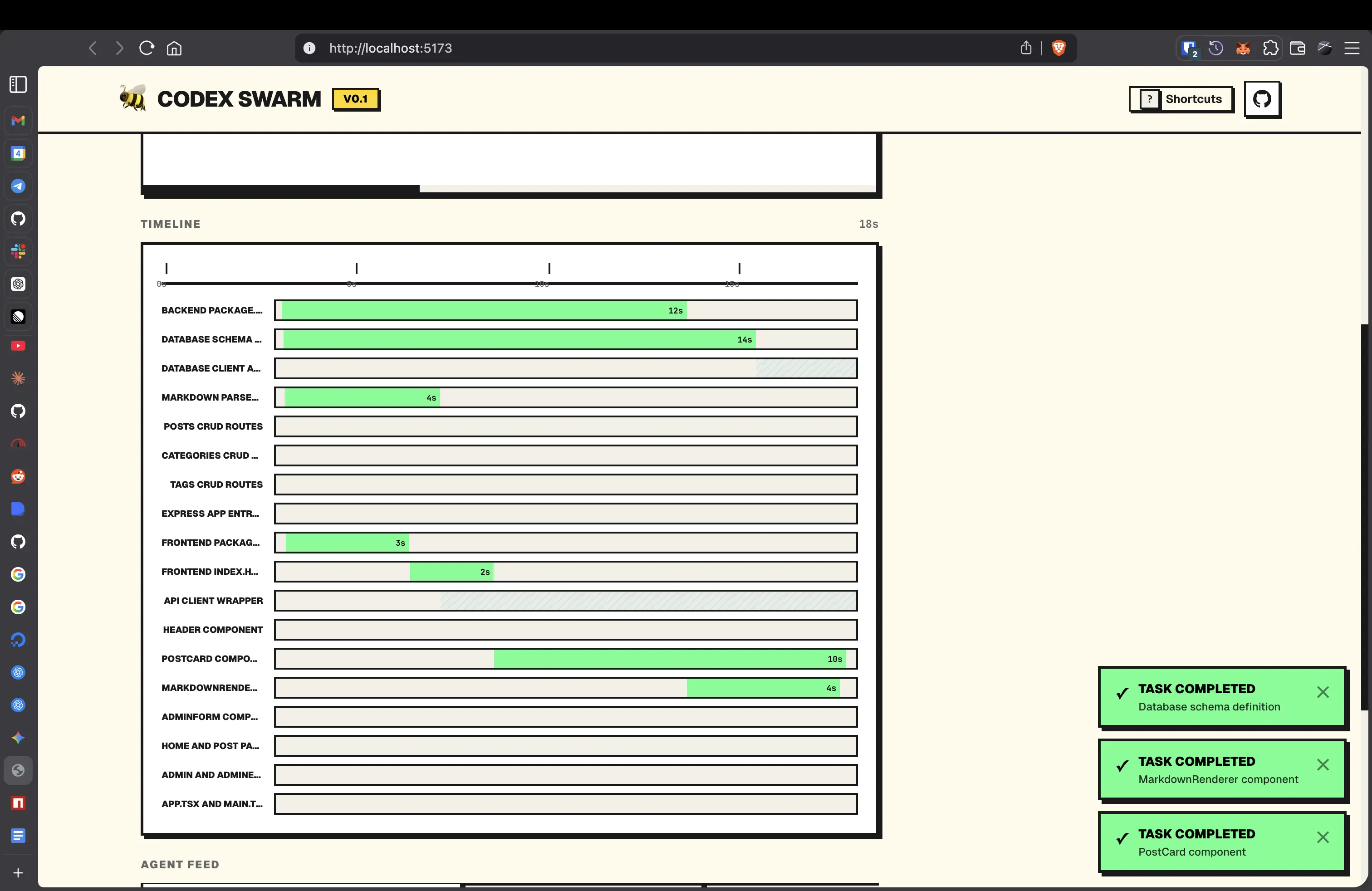
| Timeline | Gantt-style horizontal bars showing task start/end times and overlap | Every status transition |
| Diff Viewer | Syntax-highlighted unified diff for each completed task | On task completion |
| Summary | Live counters — running, queued, completed, failed, elapsed time | Derived reactively |
| Export Panel | Download full run data for post-mortem analysis | On demand |
Reactive State Management
The store (swarm.svelte.ts) uses Svelte 5's $state and $derived runes for zero-boilerplate reactivity:
// All derived values recompute automatically on any task state change
get running() { return this.tasks.filter(t => t.status === 'running').length; }
get queued()  { return this.tasks.filter(t => t.status === 'queued').length; }
End-to-End Pipeline
User Input  →  Refine  →  Decompose  →  Schedule  →  Execute  →  Merge  →  Visualize
   │              │            │              │            │           │           │
   │ raw spec     │ o3-mini    │ o3-mini      │ frontier   │ Docker    │ file      │ WebSocket
   │              │ chat API   │ JSON mode    │ scheduler  │ sandbox   │ copy      │ push
   │              │            │              │            │           │           │
   ▼              ▼            ▼              ▼            ▼           ▼           ▼
 "Build a     Clear engg    Task DAG     Ready set     Isolated    Changed    DAG lights
  REST API    brief with    with edges   computed,     containers  files      up green
  with auth"  file paths    & deps       slots filled  per task    applied    in real-time
Detailed Flow
- Spec Refinement — Raw user text →
o3-mini→ structured engineering brief with file paths, tech stack, and data shapes. - Repository Context —
git ls-filescaptures the current project structure, providing the decomposer with awareness of existing code. - DAG Generation — Refined spec + file tree →
o3-mini(JSON mode) → validated task graph. Dependencies are verified (all referenced IDs must exist). - Frontier Scheduling — Tasks with zero unmet deps are dispatched immediately up to
maxConcurrency. Each completion triggers a re-scan. - Sandboxed Execution — Full repo copy → Docker container → LLM-planned actions →
write_fileandshellcommands executed in sequence. - Diff Capture —
git diff --cachedfrom sandbox, streamed to dashboard. - Change Application — Only modified files are copied back to the original repo.
- Cascading Unlock — Completed task → dependents re-evaluated → next wave dispatched.
- Completion — When all tasks are
completedorfailed,swarm_completeis emitted with total time and success/failure counts.
WebSocket Protocol
All communication between server and dashboard uses a typed WebSocket protocol defined in types.ts:
| Direction | Message Type | Payload | When |
|---|---|---|---|
| Client → Server | start | { spec, repoPath, maxConcurrency } | User clicks "Launch Swarm" |
| Client → Server | cancel | — | User cancels the run |
| Client → Server | retry | { taskId } | User retries a failed task |
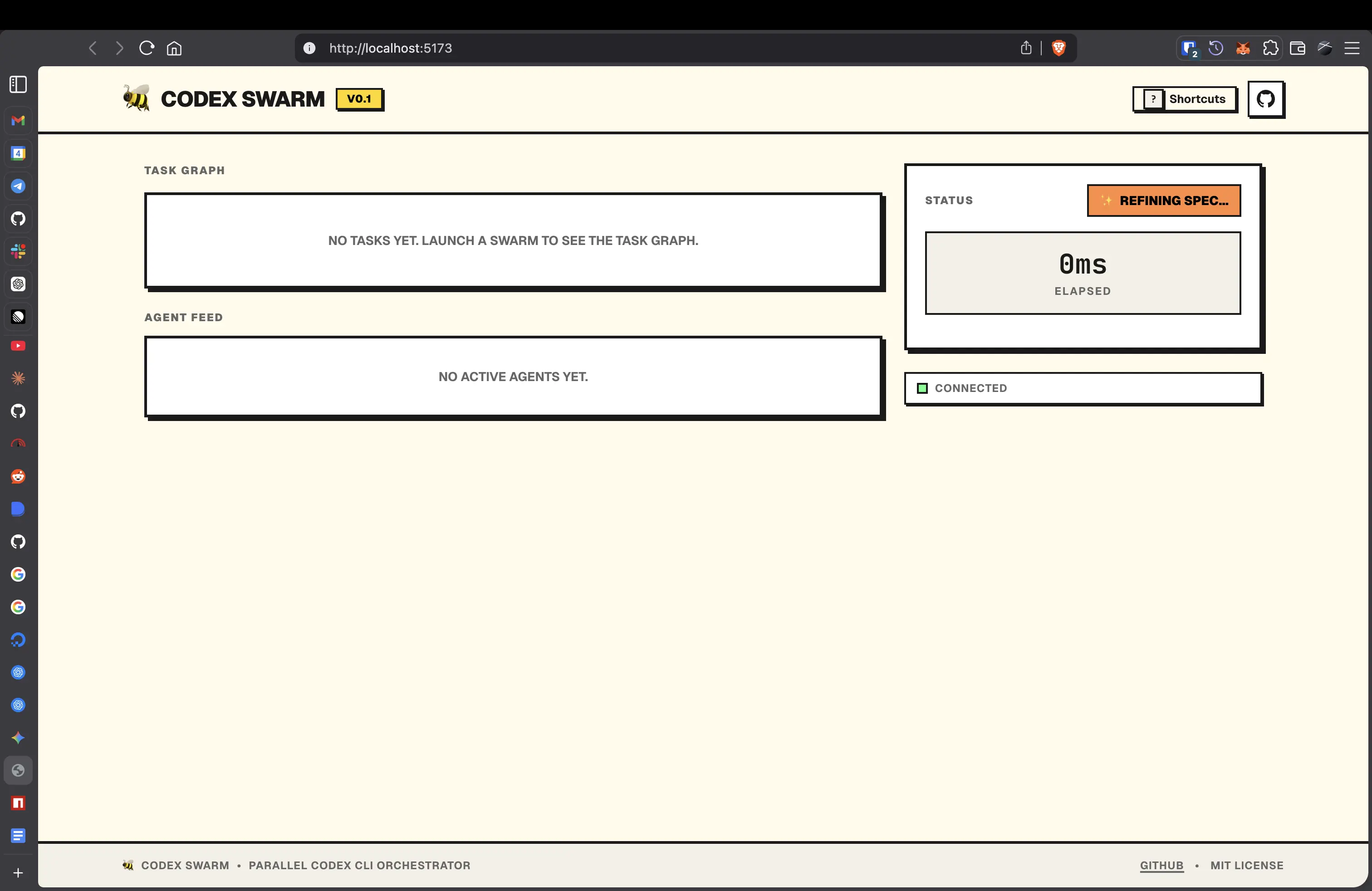
| Server → Client | refining | { spec } | Spec refinement begins |
| Server → Client | refined | { spec } | Refined spec ready |
| Server → Client | dag | { tasks[] } | DAG generated |
| Server → Client | task_update | { taskId, status, error?, timestamps } | Any task state change |
| Server → Client | agent_output | { taskId, chunk } | Streaming agent output |
| Server → Client | task_diff | { taskId, diff } | Task diff captured |
| Server → Client | swarm_complete | { totalTime, succeeded, failed } | All tasks finished |
Configuration
All configuration is centralized in config.ts with environment variable validation:
| Variable | Default | Purpose |
|---|---|---|
OPENAI_API_KEY | required | API key for OpenAI or compatible provider |
OPENAI_BASE_URL | api.openai.com/v1 | Swap to Ollama, Groq, Together AI, etc. |
DECOMPOSE_MODEL | o3-mini | Model for DAG generation |
REFINE_MODEL | o3-mini | Model for spec refinement |
AGENT_MODEL | o3-mini | Model for agent action planning |
MAX_CONCURRENCY | 4 | Max parallel Docker containers |
AGENT_TIMEOUT_MS | 600000 | Per-task timeout (10 min) |
The OPENAI_BASE_URL support means Codex Swarm works with any OpenAI-compatible API — local models via Ollama, cloud providers like Groq or Together AI, or Azure OpenAI deployments.
Tech Stack
| Layer | Technology | Rationale |
|---|---|---|
| Runtime | Node.js 22, TypeScript 5 | Native ESM, top-level await, modern APIs |
| HTTP/WS Server | Hono | Lightweight, edge-compatible, built-in WebSocket upgrade |
| Frontend | Svelte 5 (Runes) | Fine-grained reactivity without virtual DOM overhead |
| Styling | Tailwind CSS 4 + shadcn-svelte | Utility-first with accessible component primitives |
| Monorepo | pnpm workspaces | Hoisted dependencies, fast installs |
| Sandboxing | Docker | Process isolation, resource limits, reproducible environments |
| LLM | OpenAI Chat Completions API | JSON mode for structured output, streaming for real-time feedback |
What Makes Codex Swarm Unique
| Capability | Codex Swarm | Typical LLM Orchestrators |
|---|---|---|
| Task modeling | DAG with typed dependency edges | Flat lists or simple chains |
| Scheduling | Event-driven frontier scheduler | Timer-based polling or sequential |
| Parallelism | True concurrent execution bounded by maxConcurrency | Often single-threaded or fire-all |
| Isolation | Docker containers with resource caps per task | Shared process, shared filesystem |
| Conflict avoidance | File-scoped tasks + sandbox copies | Hope for the best |
| Failure handling | Recursive cascading failure + targeted retry | Retry-all or abandon |
| Visibility | Real-time DAG + streaming logs + live diffs | Post-hoc log files |
| LLM integration | Plan-then-execute (LLM plans, Docker executes) | LLM has direct system access |
| Provider flexibility | Any OpenAI-compatible API via OPENAI_BASE_URL | Locked to single provider |
Repository Structure
codex-swarm/
├── packages/
│   ├── server/                  # Orchestration backend
│   │   ├── src/
│   │   │   ├── index.ts         # Hono server, WebSocket routing
│   │   │   ├── orchestrator.ts  # DAG scheduler, task lifecycle
│   │   │   ├── decomposer.ts   # LLM-powered spec→DAG decomposition
│   │   │   ├── agent.ts        # LLM action planner (write_file/shell)
│   │   │   ├── sandbox-runner.ts# Docker container management
│   │   │   ├── config.ts       # Centralized env config
│   │   │   └── types.ts        # Shared type definitions
│   │   └── docker/
│   │       └── Dockerfile.agent # Minimal agent container image
│   └── web/                     # Dashboard frontend
│       └── src/
│           ├── app.css          # Neobrutalist design system
│           ├── lib/
│           │   ├── stores/
│           │   │   └── swarm.svelte.ts  # Reactive state (Svelte 5 Runes)
│           │   └── components/
│           │       ├── TaskGraph.svelte  # DAG visualization (SVG)
│           │       ├── AgentFeed.svelte  # Streaming agent output
│           │       ├── Timeline.svelte   # Gantt-style execution timeline
│           │       ├── DiffViewer.svelte # Syntax-highlighted diffs
│           │       ├── Summary.svelte    # Live progress counters
│           │       └── ExportPanel.svelte# Run data export
│           └── routes/
│               └── +page.svelte # Main dashboard page
└── docs/
    └── END_TO_END_WORKFLOW.md   # Step-by-step runtime walkthrough
License
MIT — see LICENSE.